Date:2026.05.07 10:00-12:00
Venue:CNV A1 1208
Abstract
This report presents our research on communication large models, which aims to extend large language models to the field of wireless communications. Our research is motivated by the observation that general large models generally lack domain-specific expertise in communications and struggle to interpret physical-layer information such as radio frequency (RF) signals.The first section introduces TelecomGPT, the first large language model tailored for communications. It covers the full-stack design spanning data processing, model training, evaluation and optimization. Centered on communication knowledge modeling, TelecomGPT enables structured comprehension and reasoning of technical standards and professional communication datasets.The second section elaborates on RF-GPT, the first large language model dedicated to RF signals. RF-GPT further incorporates RF signals as a new modality. It leverages an RF-language alignment mechanism to endow the model with the capability to perceive and reason over physical-layer information. Our studies demonstrate that existing multimodal models lack critical domain priors for RF signal interpretation, and this work offers an initial exploratory pathway to fill this research gap.Collectively, these studies pave the way for a new paradigm of AI-native networks: leveraging foundation models to deliver unified representation, cross-task reasoning, and deep integration of artificial intelligence within wireless systems
Speaker Bio
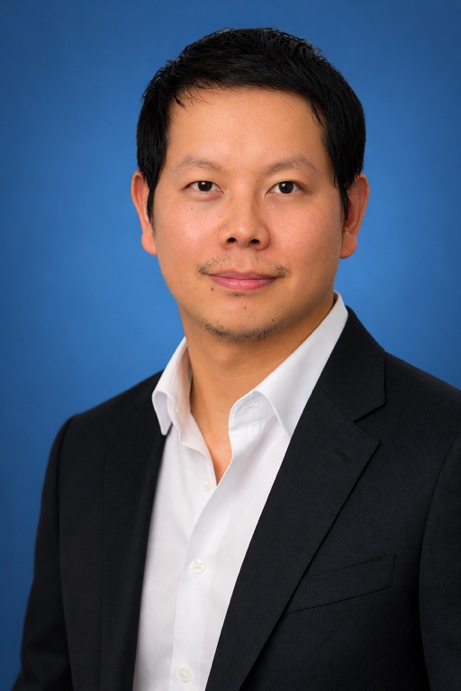
Dr. Hang Zou is a Postdoctoral Fellow at the 6G Research Center, Khalifa University, working with Prof. Merouane Debbah. He pioneered the concept of the radio-frequency language model (RFLM) and developed the first such model, RF-GPT, enabling large language models to directly perceive and reason over RF signals. He received his Ph.D. in Wireless Communications from Paris-Saclay University in 2022,under the supervision of Prof. Samson Lasaulce. Prior to joining Khalifa University, he was a Researcher at the Technology Innovation Institute, where he worked across the full LLM stack, from data pipelines and training to inference and evaluation, and developed TelecomGPT, the first telecom-specific LLMs, as well as the Falcon-Edge family of efficient language models. His research interests include 6G, semantic and goal-oriented communications, telecom-specific LLMs, edge AI, model compression, and AI-driven optimization. He has authored and co-authored publications in leading venues such as Nature Reviews Electrical Engineering and IEEE JSAC, and actively serves as a reviewer for major IEEE journals and conferences.