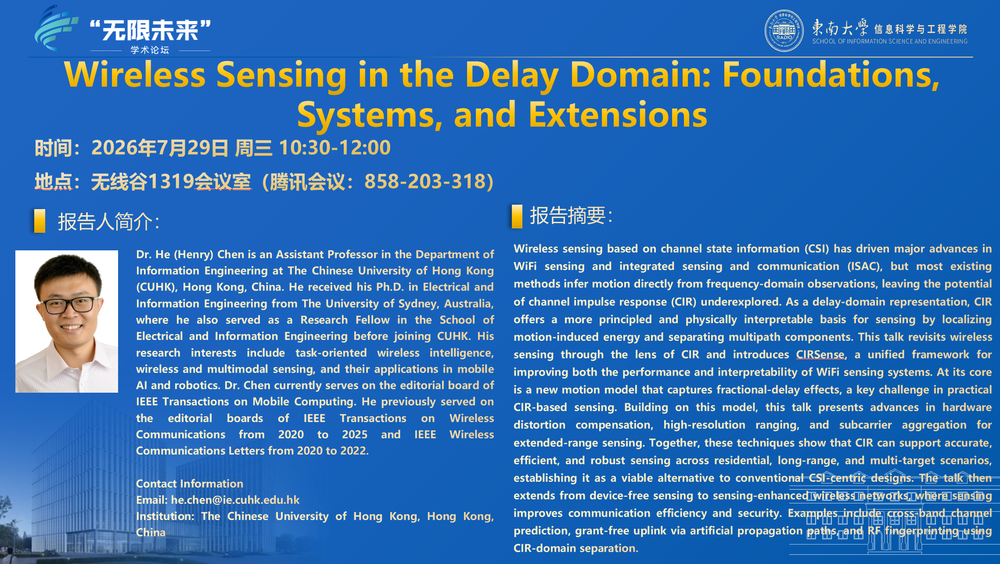
Date: 2026. 7. 29 10:30-12:00
Venue: CNV Room 1319(Tencent Meeting:858-203-318)
Abstract: Wireless sensing based on channel state information (CSI) has driven major advances in WiFi sensing and integrated sensing and communication (ISAC), but most existing methods infer motion directly from frequency-domain observations, leaving the potential of channel impulse response (CIR) underexplored. As a delay-domain representation, CIR offers a more principled and physically interpretable basis for sensing by localizing motion-induced energy and separating multipath components. This talk revisits wireless sensing through the lens of CIR and introduces CIRSense, a unified framework for improving both the performance and interpretability of WiFi sensing systems. At its core is a new motion model that captures fractional-delay effects, a key challenge in practical CIR-based sensing. Building on this model, this talk presents advances in hardware distortion compensation, high-resolution ranging, and subcarrier aggregation for extended-range sensing. Together, these techniques show that CIR can support accurate, efficient, and robust sensing across residential, long-range, and multi-target scenarios, establishing it as a viable alternative to conventional CSI-centric designs. The talk then extends from device-free sensing to sensing-enhanced wireless networks, where sensing improves communication efficiency and security. Examples include cross-band channel prediction, grant-free uplink via artificial propagation paths, and RF fingerprinting using CIR-domain separation.
Speaker: Dr. He (Henry) Chen is an Assistant Professor in the Department of Information Engineering at The Chinese University of Hong Kong (CUHK), Hong Kong, China. He received his Ph.D. in Electrical and Information Engineering from The University of Sydney, Australia, where he also served as a Research Fellow in the School of Electrical and Information Engineering before joining CUHK. His research interests include task-oriented wireless intelligence, wireless and multimodal sensing, and their applications in mobile AI and robotics. Dr. Chen currently serves on the editorial board of IEEE Transactions on Mobile Computing. He previously served on the editorial boards of IEEE Transactions on Wireless Communications from 2020 to 2025 and IEEE Wireless Communications Letters from 2020 to 2022.

Contact Information
Email: he.chen@ie.cuhk.edu.hk
Institution: The Chinese University of Hong Kong, Hong Kong, China