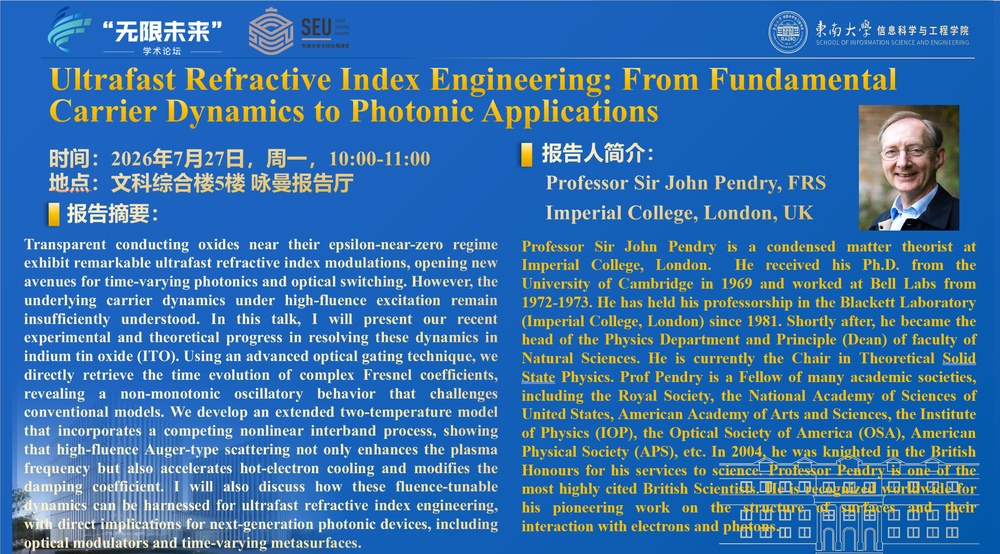
Date:2026.7.27 10:00-11:00
Venue: Sanjiang Building Yongman Hall (5th Floor)
Title:Ultrafast Refractive Index Engineering: From Fundamental Carrier Dynamics to Photonic Applications
Abstract:
Transparent conducting oxides near their epsilon-near-zero (ENZ) regime exhibit remarkable ultrafast refractive index modulations, opening new avenues for time-varying photonics and optical switching. However, the underlying carrier dynamics under high-fluence excitation remain insufficiently understood. In this talk, I will present our recent experimental and theoretical progress in resolving these dynamics in indium tin oxide (ITO). Using an advanced optical gating technique, we directly retrieve the time evolution of complex Fresnel coefficients, revealing a non-monotonic oscillatory behavior that challenges conventional models. To explain these observations, we develop an extended two-temperature model that incorporates a competing nonlinear interband process, showing that high-fluence Auger-type scattering not only enhances the plasma frequency but also accelerates hot-electron cooling and modifies the damping coefficient. Beyond the fundamental physics, I will discuss how these fluence-tunable dynamics can be harnessed for ultrafast refractive index engineering, with direct implications for next-generation photonic devices, including optical modulators and time-varying metasurfaces. This work not only clarifies the anomalous dynamics in ITO but also provides a general framework for exploring and controlling ultrafast optical responses in ENZ materials.
Speaker:

Professor Sir John Pendry, FRS
Imperial College, London, UK
Biography: Professor Sir John Pendry is a condensed matter theorist at Imperial College, London. He received his Ph.D. from the University of Cambridge in 1969 and worked at Bell Labs from 1972-1973. He has held his professorship in the Blackett Laboratory (Imperial College, London) since 1981. Shortly after, he became the head of the Physics Department and Principle (Dean) of faculty of Natural Sciences. He is currently the Chair in Theoretical Solid State Physics. Prof Pendry is a Fellow of many academic societies, including the Royal Society, the National Academy of Sciences of United States, American Academy of Arts and Sciences, the Institute of Physics (IOP), the Optical Society of America (OSA), American Physical Society (APS), etc. In 2004, he was knighted in the British Honours for his services to science.
Professor Pendry is one of the most highly cited British Scientists. He is recognized worldwide for his pioneering work on the structure of surfaces and their interaction with electrons and photons. He has also worked extensively on transport in disordered systems where he produced a complete theory of the statistics of transport in one-dimensional systems. He founded the field of “metamaterials”, a concept for engineered structures whose electromagnetic properties depend on their internal structure rather than their chemical constitution. He discovered that a perfect lens manufactured from negatively refracting material would circumvent Abbeʼs diffraction limit to spatial resolution, which has stood for more than a century. His most recent innovation of transformation optics gives the metamaterial specifications required to rearrange electromagnetic field configurations at will. In its simplest form, the theory shows how we can direct field lines around a given obstacle and thus provide a cloak of invisibility. Several realizations of this concept have been built some operating at radar and others at visible wavelengths.
Professor Pendry has won numerous awards, including the Dirac Medal in 1996, the Royal Medal in 2006, the UNESCO-Niels Bohr gold medal in 2009, the Isaac Newton Medal in 2013, the Kavli Prize in Nanoscience in 2014, the Dan David Prize in 2016, the Kyoto Prize 2024, the Copley Medal in 2025, etc. He holds honorary doctorates from 5 Universities in United States, France, Germany and Hong Kong.